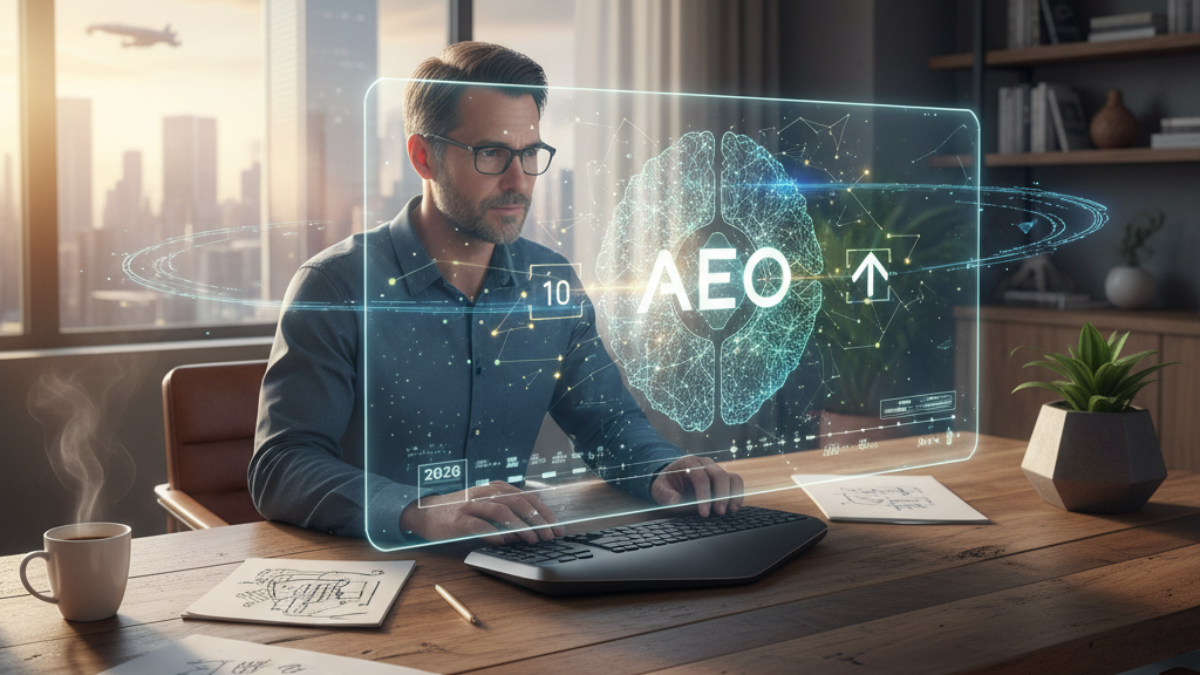
The search landscape is undergoing its most radical transformation since the invention of the backlink. As we navigate the complexities of digital marketing in this new era, traditional SEO is no longer the only game in town. We are witnessing the rise of answer engines—platforms like Perplexity, ChatGPT, and Google’s Gemini—that provide direct solutions rather than just a list of links.
Understanding the best practices for answer engine optimization aeo 2026 is now essential for any brand that wants to remain visible in an AI-driven world. This shift requires a fundamental change in how we create, structure, and distribute content across the web. If your content isn’t being ingested and cited by Large Language Models (LLMs), your digital presence may effectively disappear for a significant portion of your target audience.
In this comprehensive guide, we will explore the strategies necessary to dominate this new frontier. You will learn how to transition from traditional keyword targeting to entity-based authority. We will also dive into the technical requirements that make your data “machine-readable,” ensuring that AI agents can easily find and verify your information.
The following sections will break down the ten pillars of AEO success, providing actionable insights and real-world examples. By the end of this article, you will have a clear roadmap for future-proofing your digital strategy. Let’s explore how you can master the best practices for answer engine optimization aeo 2026 to ensure your brand remains the definitive answer to your customers’ most pressing questions.
1. Understanding the Best Practices for Answer Engine Optimization AEO 2026
To master AEO, we first have to recognize that answer engines do not “rank” websites in the traditional sense. Instead, they “synthesize” information from multiple sources to provide a single, cohesive response. While SEO focuses on driving traffic to a page, AEO focuses on getting your brand’s information included in that synthesis.
The goal in 2026 is to become the “trusted source” that the AI cites when a user asks a query. This requires a shift toward extreme clarity and factual accuracy. If an AI model cannot verify your claims against other reputable sources, it is unlikely to include your content in its generated response.
Take, for example, a company like Patagonia. When a user asks an AI, “What is the most durable eco-friendly jacket for rainy weather?” the AI looks for consensus. It scans reviews, technical specifications, and news articles. Patagonia succeeds here by having consistent, factual data across the web, making it easy for the AI to recommend them.
Defining the Difference Between SEO and AEO
Traditional SEO is about optimizing for a search engine’s algorithm to move a URL higher in a list. AEO is about optimizing for a generative model’s understanding of a topic. In AEO, the metric of success is “Share of Model” rather than “Share of Search.”
Why 2026 is the Turning Point
By 2026, the majority of informational queries will be handled by AI overlays. Users are becoming accustomed to getting answers without clicking through to websites. This means your content must be structured to be “scanned” by bots as much as it is “read” by humans.
The Role of User Intent in AEO
In the AEO era, intent is more nuanced. It’s not just about “buy” or “learn,” but about “solve this specific problem for me.” Your content needs to address the “how” and “why” with surgical precision to satisfy these complex, multi-layered AI prompts.
| Feature | Traditional SEO | AEO (2026) |
|---|---|---|
| Primary Goal | High Ranking/Clicks | Citation/Synthesis |
| Content Format | Long-form Articles | Structured Data/Direct Answers |
| Target | Search Engine Crawlers | LLMs & AI Agents |
| Key Metric | Click-Through Rate (CTR) | Attribution & Model Mention |
2. Implementing Structured Data and Machine-Readable Content
One of the core best practices for answer engine optimization aeo 2026 involves making your content as easy as possible for AI to ingest. This goes beyond basic Schema markup. In 2026, we are talking about deep semantic labeling of every data point on your page.
AI models prefer data that is structured in a way they can verify. Using JSON-LD to define entities, relationships, and facts is no longer optional. It is the bridge between your human-readable content and the AI’s knowledge graph. If the AI doesn’t have to “guess” what your content is about, it is more likely to trust it.
A real-world example of this is seen in the hospitality industry. A hotel brand like Marriott doesn’t just list “amenities” on a page. They use specific Schema types for every service—gym hours, pool temperature, and pet policies. When a user asks an AI agent, “Find me a hotel with a heated pool and 24-hour gym in Austin,” Marriott’s structured data provides the immediate, verifiable answer the AI needs.
Leveraging Advanced Schema.org Vocabularies
In 2026, you should be using specific Schema types like `Speakable`, `FactCheck`, and `Dataset`. These tell the answer engine exactly which parts of your content are meant to be direct answers. This reduces the friction for the LLM during the retrieval-augmented generation (RAG) process.
The Importance of Clean HTML and API Accessibility
Answer engines often use headless browsers or APIs to pull data. If your website is bogged down by heavy JavaScript or messy code, the AI may skip your content. Ensure your most important “answers” are delivered in clean, semantic HTML that is easily parsed by any machine.
Creating Data Tables for AI Synthesis
AI models love tables. They provide a clear structure for comparing features, pricing, or statistics. Including a “Summary Table” at the top of your long-form content is a brilliant way to provide the AI with a “cheat sheet” of your expertise, increasing the likelihood of being cited in a comparison query.
3. Mastering Natural Language Processing and Conversational Tone
The way people interact with machines has moved from “keywords” to “conversations.” Therefore, your content must mirror this shift. One of the best practices for answer engine optimization aeo 2026 is writing in a way that answers natural, spoken-word questions.
When people use voice assistants or AI chat, they use full sentences. Instead of searching “best coffee maker 2026,” they ask, “What is the best coffee maker for a small apartment that also makes espresso?” Your content should be optimized to answer these specific, long-tail, conversational queries directly.
Consider the success of sites like Healthline. They don’t just write about “Vitamin D.” They structure their articles around questions like, “What are the symptoms of Vitamin D deficiency?” and “How much Vitamin D should I take daily?” By mirroring the user’s natural language, they become the primary source for AI-generated medical summaries.
Optimizing for the “Question-Answer” Format
A highly effective strategy is to use H3 headings as questions and the following paragraph as a direct, concise answer. This format is perfect for featured snippets and AI synthesis. It provides a clear “hook” for the answer engine to grab and display to the user.
Using the “Inverted Pyramid” Style for AEO
Start with the answer, then provide the supporting details. In the world of Generative Engine Optimization, the AI wants the conclusion first. Don’t make the model (or the user) dig through 1000 words to find the “best practices” or the “final price.”
Reducing Fluff and Ambiguity
AI models are trained to detect and often ignore “marketing speak.” Words like “revolutionary,” “unprecedented,” and “game-changing” add no value to an answer engine. Focus on objective, factual, and descriptive language that provides real utility to the end-user.
4. Building Authority Through Entity-Based Content Strategy
In 2026, the concept of “keywords” is secondary to the concept of “entities.” An entity is a well-defined person, place, thing, or concept. Answer engines use Entity-Based Knowledge Graphs to understand how different topics relate to one another.
To rank well, your brand must become a recognized entity within your niche. This means you shouldn’t just write about “SEO.” You should build a web of content that connects your brand to related entities like “Google Search Console,” “Natural Language Processing,” and “User Experience.”
For example, a financial services firm like Vanguard doesn’t just target the keyword “investing.” They build authority around the entity of “Low-cost Index Funds.” They provide white papers, historical data, and expert commentary that links their brand to the broader concept of “Long-term Wealth Management,” making them an undeniable authority in the eyes of an AI.
Establishing Expertise, Experience, Authoritativeness, and Trust (E-E-A-T)
AEO is the ultimate test of E-E-A-T. Answer engines prioritize sources that have a clear “human” expert behind them. Ensure your articles have detailed author bios, links to professional profiles (like LinkedIn), and citations to external, high-authority studies.
Developing Topical Clusters for AI Context
Don’t write isolated blog posts. Create “Topic Hubs” that cover every facet of a subject. When you provide a comprehensive look at a topic, you give the AI a rich context. This makes it more likely that the AI will see your site as a “definitive guide” and use it for multi-step queries.
The Power of Third-Party Mentions
AI models don’t just look at your site; they look at what others say about you. Mentions on Wikipedia, news outlets, and niche-specific directories help “verify” your entity. Digital PR is now a core component of AEO because it builds the external validation that LLMs require for trust.
5. Technical Best Practices for Answer Engine Optimization AEO 2026
The technical side of AEO is about more than just page speed. It’s about “Machine Discovery.” One of the best practices for answer engine optimization aeo 2026 is ensuring that your site’s architecture allows AI agents to crawl and index your content without hitting roadblocks like paywalls or complex navigation.
If an AI cannot access your data, it cannot recommend you. This has led to the rise of “AI-friendly” sitemaps and robots.txt configurations. You want to make it incredibly easy for bots from OpenAI, Google, and Anthropic to see your most valuable “answer” pages while maintaining your site’s security.
A great example is a technical documentation site like Stripe’s. Their docs are a masterpiece of AEO. They are fast, cleanly structured, and use a consistent hierarchy. When a developer asks an AI, “How do I implement Stripe Elements with React?” the AI can perfectly parse Stripe’s own documentation to provide the code snippet and explanation.
Optimizing for “Zero-Click” and “Direct Answer” Metrics
In 2026, we have to accept that many users won’t visit our site. Therefore, we must optimize for the “Zero-Click” experience. This means providing enough value in the AI’s response that the user remembers your brand, even if they didn’t click. Branding within the text is key.
Implementing “Speakable” Schema for Voice AEO
As voice-activated answer engines become the norm (think AI pins and smart glasses), `Speakable` Schema is vital. This tells the AI exactly which sections of your content are most appropriate for a text-to-speech engine to read aloud.
Managing Your Brand’s “Digital Footprint”
AEO involves managing your presence on platforms where AI gathers data. This includes Reddit, Quora, and industry forums. If the “crowd” on Reddit says your product is bad, the AI will likely include that sentiment in its answer. Monitoring and engaging in these communities is a technical necessity for modern brand management.
6. Leveraging Multimedia for Visual and Multimodal AEO
We are moving into a “multimodal” world where AI can “see” images and “hear” audio. Therefore, optimizing your multimedia is a critical part of the best practices for answer engine optimization aeo 2026. AI models use computer vision to understand what is happening in your images and videos.
Your alt text should no longer be a string of keywords. It should be a descriptive, factual narrative of what the image represents. If you have an infographic, provide a text-based transcript or a structured data breakdown of the data points within that graphic.
A real-world scenario: A home DIY brand like Home Depot uses video tutorials. By providing detailed “Video Object” Schema and timestamped transcripts, they allow AI to answer specific questions like, “At what point in the video do they show how to apply the primer?” The AI can then jump the user to that exact moment or summarize the steps in text.
Visual Search and Image Recognition
Optimize your images for “Visual AEO.” Use high-resolution, original photography. AI models like Google Lens or GPT-4o can identify products and objects. If your product images are clear and tagged correctly, the AI can identify them in a user’s photo and provide a direct link to purchase.
Audio Optimization for AI Synthesis
If you produce podcasts or webinars, provide high-quality transcripts. AI models “read” these transcripts to understand your brand’s unique insights. This allows your spoken expertise to be cited in written AI answers, expanding your reach far beyond the audio format itself.
The Role of Neural Information Retrieval in Multimedia
Modern AI uses neural information retrieval to find the most relevant “piece” of content across different media types. By aligning your text, images, and video around a single, clear message, you create a “multimodal authority” that is hard for AI models to ignore.
7. The Role of Citations and Digital PR in Answer Engine Success
Citations are the “backlinks” of the AEO era. When an AI model provides an answer, it often includes footnotes or links to its sources. Getting your link into those footnotes is the ultimate goal. This is why Generative Engine Optimization relies heavily on digital PR and brand mentions.
AI models are trained to avoid “hallucinations” by grounding their answers in real-world data. If your brand is frequently mentioned as an authority by other trusted sites, the AI is more likely to use you as a primary source. This creates a “virtuous cycle” of authority.
Look at a brand like NerdWallet. They have spent years building a reputation for unbiased financial advice. Because they are cited by major news outlets and have thousands of high-quality backlinks, AI models “trust” their calculators and guides more than a random personal finance blog.
Moving from Backlinks to Brand Mentions
In 2026, a “linkless mention” on a high-authority site is nearly as valuable as a backlink. The AI detects the association between your brand and a topic. Focus on getting featured in expert roundups, guesting on authoritative podcasts, and being quoted in industry reports.
Managing the “Consensus” Around Your Brand
AI often looks for a consensus. If 10 different reputable sites say your software is the “best for small business,” the AI will state that as a fact. Your PR team should focus on ensuring that your key value propositions are consistently reflected across the entire digital ecosystem.
Using Data-Driven PR to Gain Citations
One of the best ways to get cited by an AI is to produce original research. If you publish a study with unique statistics, you become the “original source” for that data. When an AI is asked about those statistics, it will cite your study, providing you with a high-value AEO citation.
8. Optimizing for User Experience and the “Helpful Content” Standard
The “Helpful Content” update was just the beginning. In 2026, answer engines are designed to prioritize content that provides the best user experience. This means your content must be easy to navigate, fast to load, and free of intrusive ads that hinder “machine reading.”
AEO is not just about the bot; it’s about the human who eventually interacts with the brand. If an AI sends a user to your site and the user immediately bounces because of a poor UI, the AI’s “feedback loop” will eventually learn that your site is not a good recommendation.
Consider a site like Canva. Their user experience is seamless. Whether a user arrives via a search engine or an AI recommendation, the path to “creating a design” is immediate. This high level of utility reinforces Canva’s authority in the “design tool” space for both humans and AI models.
Prioritizing Mobile-First and AI-Agent UX
Many “users” in 2026 will be AI agents performing tasks on behalf of humans. Does your site have a clear structure that an agent can navigate to “book a flight” or “check a price”? Designing for “Agentic Workflows” is a futuristic but necessary part of AEO.
The Impact of “Time-to-Answer”
How quickly can a user (or bot) find the answer on your page? If your answer is buried under three pop-ups and a “Join our newsletter” overlay, you will lose in the AEO race. Streamline your page design to prioritize the “Direct Answer” at the very top.
Maintaining Content Freshness
AI models are increasingly being trained on real-time data (or using search-enabled plugins). Keeping your content updated is a vital part of the best practices for answer engine optimization aeo 2026. Outdated facts can lead to your site being “blacklisted” as an unreliable source by sensitive LLM filters.
9. Measuring Success: New KPIs for the AEO Era
You cannot manage what you cannot measure. Traditional metrics like “organic traffic” are becoming less reliable as zero-click searches rise. We need new Key Performance Indicators (KPIs) to track our success in answer engine optimization.
In 2026, we look at “Citation Share”—the percentage of time an AI model cites your brand when asked about your industry. We also look at “Sentiment Analysis” of AI responses. Is the AI speaking about your brand in a positive, authoritative, or neutral tone?
A company like Salesforce might track how often its “State of Marketing” report is cited by ChatGPT when users ask for marketing trends. By monitoring these citations, they can judge the effectiveness of their AEO strategy even if the user never actually visits the Salesforce website.
Tracking “Share of Model”
This involves using tools that query various LLMs (ChatGPT, Gemini, Claude, Perplexity) to see which brands are being recommended for specific prompts. This gives you a clear picture of your “AI Visibility” compared to your competitors.
Analyzing Footnote and Source Links
If you are using tools like Perplexity, look at which of your pages are being used as sources. Are they your deep-dive guides or your product pages? This data tells you what type of content the AI finds most “trustworthy” and “useful” for its synthesis.
Monitoring Brand “Verifiability”
Use AI tools to “audit” your brand. Ask an LLM, “What are the pros and cons of [Your Brand]?” The answer will reveal what the AI “thinks” of you based on its training data. If the “cons” are based on outdated or incorrect info, you know you have a PR and AEO problem to solve.
10. FAQ: Common Questions About Answer Engine Optimization
What is the difference between SEO and AEO?
SEO (Search Engine Optimization) focuses on ranking a website in a list of results on a search engine like Google. AEO (Answer Engine Optimization) focuses on getting your content cited as the direct answer in AI-generated responses from platforms like ChatGPT or Perplexity.
How do I get my website cited by AI models?
To be cited, your content must be factual, authoritative, and structured for machine readability. Use Schema markup, provide direct answers to common questions, and ensure your brand is mentioned by other high-authority, trusted sources across the web.
Is keyword research still important for AEO in 2026?
Yes, but the focus has shifted. Instead of “short-tail” keywords, you should focus on “intent-based” questions and “entities.” You want to understand the conversational prompts your customers are using and ensure your content addresses those specific needs.
Does AEO replace traditional SEO?
AEO does not replace SEO; it is an evolution of it. You still need a fast, accessible, and well-linked website. However, you must now layer AEO strategies on top of your SEO foundation to capture the growing “zero-click” and AI-driven market.
How does “E-E-A-T” affect my AEO rankings?
E-E-A-T (Experience, Expertise, Authoritativeness, Trustworthiness) is the backbone of AEO. AI models are trained to prioritize information from reliable, human-vetted sources. Clear author attribution, factual accuracy, and high-quality external citations are essential for building this trust.
Can I use AI to write my AEO content?
While you can use AI as a tool, “pure” AI-generated content often lacks the unique insights and “experience” that answer engines look for. To succeed in AEO, your content should provide “information gain”—new, unique data or perspectives that aren’t already in the AI’s training set.
What is a “Zero-Click” search?
A zero-click search is a query where the user’s question is answered directly on the search results page (or by an AI) without the user needing to click on any website links. AEO is specifically designed to win in this zero-click environment.
How do I optimize for voice search in 2026?
Voice search is a subset of AEO. Optimize by using natural, conversational language, focusing on local “near me” queries, and using `Speakable` Schema to tell AI agents which parts of your text are best for reading aloud.
Conclusion: Mastering the Future of Search
As we have explored throughout this guide, the best practices for answer engine optimization aeo 2026 represent a significant shift in the digital marketing landscape. We are moving away from a world of “links and clicks” toward a future defined by “answers and authority.” By focusing on structured data, conversational content, and entity-based strategy, you can ensure your brand remains relevant.
The key takeaway is that AEO is about building trust—both with the AI models that synthesize information and the human users who rely on those answers. Whether it’s through meticulous Schema markup or high-authority digital PR, your goal is to become the “definitive source” in your niche. The strategies we’ve discussed, from multimedia optimization to measuring “Share of Model,” provide the framework for this success.
Don’t wait for your organic traffic to disappear before you start taking AEO seriously. The transition is happening now, and those who adapt early will reap the rewards of being the first “trusted answer” in the AI era. Start by auditing your current content for machine-readability and begin building the topical authority that 2026 demands.
We invite you to join the conversation. How is your brand preparing for the rise of answer engines? Leave a comment below or share this guide with your team to start building your 2026 strategy today. The future of search is conversational, and it’s time for your brand to start talking.